Regular oil changes are crucial for extending the lifespan of your vehicle.
Did you know there are two methods for changing oil: the top-up method and the bottom-drain method?
We shall detail the characteristics of each approach.
Top-up oil change procedure

■No need for lifting
Reduced working time
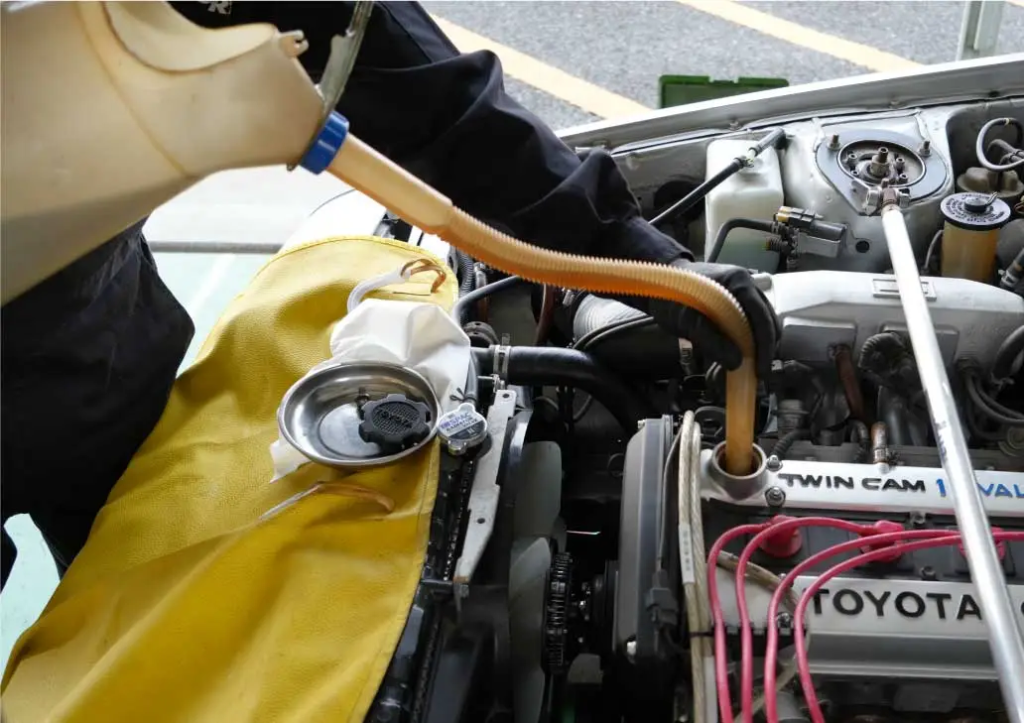
Prepare the oil changer,
open the bonnet and remove the oil level dipstick.
As no lifting is required, the work can be carried out smoothly.

■Oil Injection
Inject the specified quantity of fresh oil,
check the oil level,
then start the engine to verify there are no leaks.

Lower drain oil change procedure

■Lift the vehicle
Raise the vehicle
Lift the vehicle and prepare the necessary tools (wrench, oil pan).

■Loosen drain bolt,
drain oil
Loosen the drain bolt beneath the engine
and drain the oil into a container.
※Depending on the vehicle, it may not be possible to drain all the oil completely.

■Filling with new oil
Re-tighten the drain bolt to the correct torque and fill with new oil.
Check the oil level, start the engine, and check for leaks.
Finally, check the oil level again.
Comparison Table of Top-Pulling and Bottom-Pulling
| Top extraction | Bottom extraction | |
| Method | Suction from the oil level gauge insertion point | Drainage from the drain bolt |
| Lift-up | Not required | Required |
| Oil filter replacement |
Requires separate work (as lifting is necessary) |
Can be carried out simultaneously |
| Advantages | Short working time | Can be carried out on any vehicle type |
| Disadvantages | Not applicable to certain vehicle models | May require considerable time to complete |
Top-Drain Oil Change Features
Short operation time
As no lifting is required, the work can be completed smoothly.
Minimal residual oil
With top-drain oil changes, the hose tip reaches the bottom of the sump,
resulting in less residual oil during draining.
Bottom-Drain Oil Change Features
Suitable for all vehicle types
Bottom-drain oil changes can be performed on any vehicle model.
Undercarriage inspection possible
As the vehicle is lifted during the oil change,
damage or corrosion on undercarriage components can be checked.
Summary
Both top-off and drain-and-refill methods for oil changes have their respective advantages.
Top-off offers benefits such as shorter working time and is particularly efficient when only an oil change is required.
Conversely, drain-and-refill allows for inspection of the undercarriage, which is an advantage.
Whilst we recommend top-off, we also offer drain-and-refill services.
A small amount of residual oil remains regardless of the method used.
It is impossible to replace all engine oil in one go,
as some remains in the sump and the engine’s internal circulation system. Therefore, regular oil changes are crucial.
Failure to change it regularly can lead to increased internal engine wear, sludge build-up,
and in the worst case, potential engine fire.
The primary roles of engine oil are
lubrication, reducing friction between engine components, enhancing cooling efficiency, and preventing corrosion.
Thus, engine oil is critically important for maintaining engine performance and longevity.